

Sustainability is a strategic imperative for Unilever and a critical part of our Growth Action Plan 2030.
In May last year, we set out our refocused approach to help accelerate action on four key priority areas: climate, nature, plastics and livelihoods.
Since then, we’ve been laying the foundations for more focused delivery and improving our underlying data, monitoring and reporting systems.
There’s more to do, but we’re making encouraging early progress against our near- and medium-term goals.
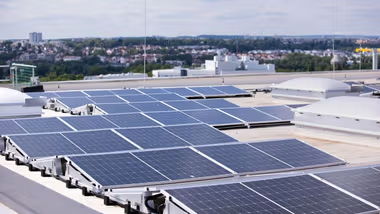
Seizing climate opportunities to reduce value chain emissions
Our Climate Transition Action Plan (CTAP) sets out three stretching science-based targets, covering operational (Scope 1 and 2) and value chain (Scope 3) emissions.
Against our goal of 100% absolute reduction in Scope 1 and 2 GHG emissions by 2030, we’ve delivered a 72% reduction from our 2015 baseline.[a] Lowering Scope 3 emissions from raw materials and ingredients (our biggest source of emissions) is our immediate priority. Key drivers include our Supplier Climate Programme and the transformation of our palm oil supply chain.
This is a huge challenge, and we know the pathway to reaching our targets won’t be linear. Against our 2021 baseline, we’ve reduced our Scope 3 forest, land and agriculture (FLAG) GHG emissions by 14%, and our Scope 3 energy and industrial emissions by 8%.
Advocacy is a critical part of our CTAP. We’re deepening our advocacy work and engaging our trade associations, encouraging them to speak up on climate. We need enabling policies that drive the global transition to net zero to accelerate our own mitigation actions and to achieve our goals.
Scaling nature protection, restoration and regenerative agriculture programmes
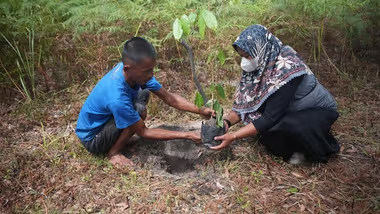
In 2024, we set new goals to implement regenerative agricultural practices on 1 million hectares of agricultural land and to help protect and restore 1 million hectares of natural ecosystems by 2030. In total, we now have 23 active regenerative agriculture projects and 13 protection and restoration programmes, spanning almost 130,000 and 425,000 hectares respectively.
A cornerstone of our approach is maintaining deforestation-free sourcing for key commodities. Through our continued investment in infrastructure, supplier verification and support for smallholder farmers, we achieved 97% deforestation-free order volumes of palm oil, paper and board, tea, soy and cocoa in 2024. We also sourced 79% of our key crops sustainably and have 21 water stewardship programmes in water-stressed areas, which we aim to accelerate this year.
We’re working pre-competitively with businesses who share our suppliers, such as PepsiCo in Iowa, to scale regenerative agriculture programmes further. We’re also stepping up our advocacy with industry coalitions, calling for stronger policies to accelerate business efforts to halt and reverse nature loss.
Reduction, circulation and collaboration to accelerate plastics progress
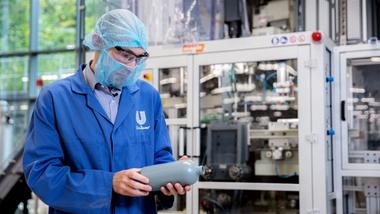
We’re aiming to reduce our virgin plastic footprint by 30% by 2026 and 40% by 2028 from a 2019 baseline. So far, we’ve reduced our virgin plastic use by 23%, by designing lighter packaging and using more recycled plastic, which now forms 21% of our global portfolio.[b]
We’re also aiming for 100% of our plastic packaging to be reusable, recyclable or compostable, by 2030 for rigid packs and 2035 for flexible packs. 57% of our plastic packaging currently falls into these categories (76% rigids, 13% flexibles).
Packaging innovation is driving progress on rigids, but our focus is on developing alternatives for hard-to-recycle flexible packaging, including plastic sachets. We’re boosting our packaging R&D investment and exploring new paper-based flexible packaging materials and technologies, alongside new formats and reusable models.
Scaling new packaging solutions economically involves major transformation. It requires infrastructure, regulation and collaboration across the entire packaging value chain. As co-chair of the Business Coalition for a Global Plastics Treaty, we’re calling for a legally binding plastics treaty that sets global rules on critical enabling policies, like extended producer responsibility.
Improving livelihoods throughout our global value chain
Our 2026 goals focus on creating change for the people who contribute to our business success, including smallholder farmers, workers of our suppliers and SMEs in our retail value chain.
In 2024, we helped over 80,000 smallholder farmers access livelihoods programmes and we helped 2.58 million SMEs grow their businesses through our digital ordering platforms.
We’re also asking suppliers to sign our Living Wage Promise, a commitment to assess and act upon their living wage gap. Suppliers representing 32% of our procurement spend have registered, and we’re working with the Sustainable Trade Initiative to provide capability-building support.
We’re advocating for industry action and government policy shifts that support decent livelihoods and enable global progress, and support the WageIndicator Foundation, which publishes living wage data in over 170 countries.

Our 2025 sustainability priorities
This year, our priority is to continue to scale our innovations and partnerships, engage suppliers and advocate for system-wide policy interventions.
Our climate performance reflects the changes we made in 2024 to broaden the emissions that fall within the scope of our baseline. See [page 243 of] our 2024 Annual Report and Accounts for further information.
Our plastics performance reflects the changes we made in 2024 to improve the accuracy of our virgin plastic and recycled plastic packaging reporting. See [page 259 of] our 2024 Annual Report and Accounts for further information.
Related articles
Unilever solar electricity deal powers renewable energy use in India
We’re partnering with our collaborative manufacturers in India to tackle climate change and increase renewable energy use. Learn how a joint power purchase agreement offers a new way to cut value chain emissions and achieve 25% cost savings on electricity.

Unilever is testing refill solutions to tackle plastic waste
Unilever is running refill pilot projects globally, seeking ways to reduce virgin plastic use and tackle plastic sachet waste. Learn how insights from three emerging markets are helping us understand the barriers to scaling reusable packaging models.

Unilever invests in biotech partnership to identify alternative cleaning ingredients
Through a new partnership, we’re aiming to develop a variety of sugar cane to extract plant-based oils for use in our cleaning ingredients. Read how this industry-first could support our ambition to deliver net zero emissions across our value chain.