

When it comes to beauty and wellbeing products, shoppers want to be informed about ingredients, science and formats. They check reviews, search for proof on social media and delight in trying new trends.
According to data from AWISEE, 87% of beauty product discovery now happens via social platforms, and a recent survey from Talker Research on behalf of Revance found that 91% of US adults aged 30–54 say they’re more ingredient-aware than ever before.
Claims matter, trends move fast – and so must we. That’s why across Unilever’s €12.8 billion Beauty & Wellbeing business we’re using AI, automation and machine learning to speed up our innovation process beyond anything previously possible.
Turning AI-powered insights into innovation
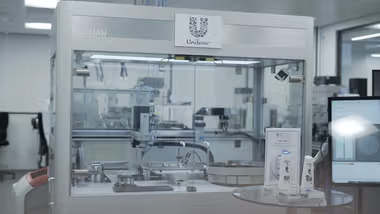
Our innovation process has always started with the consumer – looking at their needs, wants and desires. Now we can assess consumer insights 60% faster, using tech to analyse brand sentiment, buzz, engagement and search terms, and surfacing what’s driving real conversations in culture. Over 1,000 external data sources, such as social media, search, retail and competitor activity, are automatically analysed each month to give our teams a real-time, global pulse on emerging trends.
At the heart of this transformation are our unique, always-on AI insights tools. Once trends have been spotted, our experts are using new AI tools to turn them into actionable insights by combining their findings with our very own R&D databases. This means we can rapidly delve into our ingredients libraries, formulation trials, sensory tests, consumer studies, packaging specifications and claims, and work out how to design effective new science-led products that match consumer needs and wants.
Already we’ve been able to cut formulation cycles from five to six rounds to just one or two. Concept-to-R&D-brief time has been reduced from months to days. And our claims generation process is 75% quicker.
Digital tests meet human experience
Another way we’re using AI is to mine the wealth of data we’ve amassed across the R&D processes. We’ve invested in building structured, standardised datasets which allow us to explore the vast amount of biological data we own, completing complex research in record time.
As part of this, we’re using virtual cohorts: AI-created sample groups built from Unilever’s microbiome datasets. With these digital twins, we can evaluate how specific groups – based on age, skin type, hair type, location and so on – would respond to formulas, concepts, claims and sensorials. We can analyse around 2,500 subjects simultaneously, cutting time and costs.
Our ‘R&D Assistant’, Unilever’s own AI-powered agent, also connects over 150,000 scientific documents from more than a century of research, letting our scientists query insights in their natural languages around the globe.
We’re not replacing real-world testing, but it’s an invaluable way for our experts to access and explore vast amounts of data, faster.
Real products from AI research
AI-driven product innovation has already helped spark new launches that are growing our brands, like Pond’s Skin Institute’s Hydra Miracle range. The hero ingredient is Cera-Hyamino™ technology, a blend of pro-ceramides, hyaluronic boosters and GAP amino, developed to strengthen the skin barrier and deliver lasting hydration.
The claims are significant: 67 times barrier resilience power, a 100% hydration boost and clinical results showing 78% more hydrated skin from day one. And it couldn’t have happened without AI. Our scientists were able to develop Cera-Hyamino™ technology at speed because digital tools were able to analyse our microbiome data and find connections that humans alone simply couldn’t have spotted.
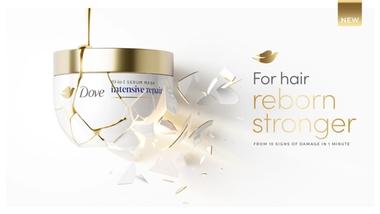
Another science-backed product design success story is Dove’s Damage Therapy range, which features Bio-Protein Care technology to refill hair protein that’s lost to daily damage from heat styling and colouring.
Scientists at our Materials Innovation Factory used advanced measurement and world‑leading robotic capability to visualise structures at a nano scale and explore more than 100,000 data points on hair properties. This helped them to understand how formulas could penetrate the hair fibre effectively.
We’ve since filed five patents for the active ingredients used in Dove Damage Therapy, and it’s driving growth for our biggest brand. Dove reported double-digit growth in 2025, supported by the successful roll-out of the Damage Therapy range in over 35 countries during Q3.
The next era of innovation
“For our 4,500 researchers, AI isn’t just a time-saver. It’s changing how we discover, collaborate and innovate,” explains Jason Harcup, Chief R&D Officer of Unilever Beauty & Wellbeing.
“Structured data, AI and human creativity are redefining what’s possible in R&D, and shaping the next era of innovation at Unilever,” he adds.
Frequently asked questions
How is AI speeding up product development in Unilever Beauty & Wellbeing?
AI is enabling the experts in Unilever’s Beauty & Wellbeing teams to analyse consumer insights 60% faster than before, helping to reduce formulation cycles from five or six rounds to just one or two, and cut concept-to-R&D-brief time from months to days. The claims generation process is now 75% quicker. Together, these gains mean Unilever teams can move from spotting a consumer trend to developing a science-backed product response at a pace that was previously impossible.
How is Unilever using AI to create products for different consumer demographics?
Our teams are using AI to create virtual cohorts that represent a range of demographics, based on Unilever’s microbiome datasets. This allows scientists to evaluate how specific consumer segments would respond to new formulas, concepts, claims and sensory profiles before any physical testing takes place. Unilever can analyse around 2,500 virtual subjects simultaneously, significantly reducing both the time and cost of early-stage R&D without replacing real-world trials.
How does Unilever use AI to track beauty trends?
Our teams are using AI to automatically analyse over 1,000 external data sources every month, spanning social media, search engines, retail platforms and competitor activity, to identify emerging trends in real time. New tools highlight brand sentiment, consumer buzz, engagement patterns and search behaviour to surface what is genuinely driving cultural conversations around beauty and wellbeing. This always-on intelligence feeds directly into the product development process, allowing Unilever’s R&D teams to act on trends quickly.
Related articles

The skinification of scalp care: Unilever’s expertise delivers on demand
Demand for sophisticated scalp care solutions is growing fast. Find out how Unilever Power Brands Dove and Clear are seeing success with advanced new premium formulas that combine proven efficacy with sensorial and aesthetic appeal.
How AI is helping drive Desire at Scale across Unilever
AI-powered content creation is fuelling a marketing transformation that is delivering growth and reach across our brands. Here are four Unilever AI case study success stories.

Unilever’s Beauty & Wellbeing business: insights, inspiration, innovation and growth
Discover how acting on evolving consumer needs is driving differentiation for Unilever’s Beauty & Wellbeing business.