How Unilever’s science is shaping the future of consumer goods
Published:
Dr Samantha Samaras reveals how Unilever is using AI and advanced technology to design biology-led sensorial products that go beyond functional and deliver desire, performance and growth.
Dr Samantha Samaras, SVP, Science & Technology, Personal Care
Wellbeing isn’t just something we think or choose. It’s something we experience – continuously shaped by the routines we repeat and the signals our body receives from the world around us.
Traditionally, wellbeing has been framed as a state of mind or a product of individual habits. And while we’ve long understood the role of sleep, exercise and nutrition, this view is incomplete.
Now, Unilever’s science has revealed something deeper: that our wellbeing appears to be shaped by the interaction between mind, body and everyday experiences.
From diet to home and personal care, consumers are increasingly choosing products that help make them feel better. A growing wellness market represents a major opportunity for Unilever – and our latest insights are already influencing product development and will be central to our future growth.
How science, AI and sensorials are creating desire at scale for Unilever
Our new scientific research suggests how we feel is influenced by biological signals across the body, not just the brain. And the choices we make every day can affect this.
Our routines – how we wash in the morning or reset at the end of the day – provide repeated signals that help shape our emotional state over time. It is in these moments that products can move beyond function and begin to influence how we feel. Sensorial signals, from scent to touch, can act as neurological shortcuts to confidence, calm or comfort. In this way, the products we use in the shower, on our face and in our home can help move us to a more positive state of being. At scale, this is a significant driver of preference, loyalty and growth.
AI and advanced technologies are allowing us to uncover and design around these biological connections more quickly and create science-backed products that not only perform as a beauty and personal care product but create a wellness experience.
Unilever’s products combine science and sensorials to boost wellbeing
Research into sensorial signals – from scent to texture – shows how products can trigger measurable emotional and physiological responses, creating new pathways to consumer preference and repeat use. We’re already using this approach to deliver products that can help boost wellbeing.
Our recent study with the University of Liverpool Brain and Behaviour Lab showed that the scent of Lux Magic Orchid shower gel boosted confidence in the blink of an eye. Smell is the only sense directly linked to our brains, so this response happened in 100 milliseconds – faster than conscious thought.
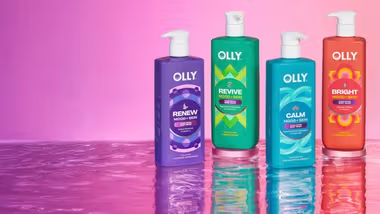
Olly is also using a combination of science and sensorials to meet consumer needs, with its new range of mood-boosting body washes. Our scientists measured tiny electrical signals in the brain, exploring how different fragrances impacted emotional states and then used these insights to create a new range which can help increase relaxation or even boost energy.
Dove’s Scalp + Hair Therapy range focuses on supporting scalp health, the biological foundation for strong hair. Hair thinning and hair fall can significantly affect self‑confidence, so addressing the problem can help boost a sense of wellbeing, and by pairing science with elevated sensorials, fragrances and packaging design, the range is transforming everyday care into a more holistic ritual.
For the first time, we can see a consistent relationship between the skin microbiome and our psychological wellbeing. This opens up entirely new ways to design products that work with the body’s biology, rather than simply acting on the surface.
Dr Samantha Samaras, SVP, Science & Technology, Personal Care
Our science is decoding the skin–wellbeing connection
One of our most significant research areas is exploring how our skin, and specifically the skin microbiome, can affect our wellbeing.
The body is a complex interconnected network. The microbiome, made up of trillions of bacteria that live on us and inside us and which have evolved with us, is a central part of this network. Unilever has been at the forefront of microbiome research for more than 20 years. Since publishing our research in 2003, we’ve analysed more than 30,000 samples and now own more than half the world’s skin microbiome data.
We’ve learnt that different parts of our bodies function like distinct ecosystems. The microbes that live in your gut are very different from what lives on your skin, and what lives on your face is not the same as what lives on your scalp or your underarms. We also found that higher levels of a common skin bacterium, Cutibacterium, on the face and underarms is associated with lower perceived stress and improved mood.
For the first time, we can see a consistent relationship between the skin microbiome and our psychological wellbeing. How we feel affects our skin and our skin may influence how we feel. This opens up entirely new ways to design products that work with the body’s biology, rather than simply acting on the surface. We’re already using these insights to create science-backed skincare products for brands like Dove, Vaseline and Pond’s Skin Institute.
How Unilever’s using technology to unlock wellbeing
Advances in technology have changed how we are discovering and developing wellbeing products. AI is shifting our R&D from observation to prediction – enabling Unilever to model biological systems, simulate outcomes and design products with greater precision than ever before. We also have the highest concentration of robots doing material chemistry anywhere in the world.
Our scientists can now run thousands of controlled experiments in parallel, testing formulations, environments and biological responses. What once took months can now be done in days, and we are creating a deeper understanding of patterns that were previously invisible.
This progress heralds a shift in consumer goods, from products that deliver function to those that work with human biology to create desire, performance and growth. For Unilever, this is how we will continue to build competitive advantage in the next era of beauty and personal care, integrating mind and body, elevating everyday wellbeing and creating desire at scale.
Unilever is one of the world’s leading authorities in skin microbiome research. Here Cheri Chu, Associate Director for Unilever Research & Development, delves into some of our most exciting discoveries and how they’re shaping products of the future.
Consumer demand for holistic products that help us feel and look good is growing. We spoke to Timo Giesbrecht, Sensory Perception & Neuroscience Lead, R&D, about how Unilever is using neurosignalling to create a new generation of personal care products.
Groundbreaking research reveals for the first time that the skin microbiome on four skin areas – the face, scalp, forearm and underarm – is associated with psychological wellbeing. The Unilever team behind the discovery explain their findings.