

Unilever is expanding its digital twins in manufacturing by partnering with Accenture to bring next-generation technology to its factory network. Powered by AI-enabled insights and emerging agentic capabilities, more than 40 digital twins will become operational over the next 18 months, helping teams work more effectively and creating a scalable blueprint for global rollout.
“Through our partnership with Accenture to accelerate digital twins, we are turning innovation into measurable impact to create desirable brands for our 3.7 billion consumers worldwide,” says Adam Raeburn-James, Global VP for Digital Business Operations, Unilever.
The new technology will provide manufacturing teams with advanced tools that will allow them to identify issues earlier, simulate scenarios faster and make smarter decisions across the production cycle. Further advances in smart manufacturing and predictive analytics will also help factories improve quality, boost efficiency and respond more quickly to consumer demand.
Building on success
The announcement builds on Unilever’s commitment to scale next-generation technology across its business operations, including identifying and testing new AI solutions through the AI Horizon3 Lab in Toronto, Canada.
“Having invested early in AI, Unilever is setting the standard for pairing advanced tools with smart process design and disciplined execution on the shop floor,” says Nicole van Det, CEO, Accenture Netherlands and Nordics. “Together, we’re setting the benchmark for how industrial AI creates measurable value in the consumer goods sector.”
Digital twins are already delivering tangible proof of the benefits, creating a strong foundation for this new expansion.
Increasing quality, reducing waste
Personal Care, for example, has seen a rise in manufacturing efficiency and a reduction in waste since this technology was introduced at some of its factories. The digital twin supporting the production of Dove, Degree and Axe at the Raeford plant in North Carolina, in the US, for example, was able to predict 95% of process flow restrictions in deodorant stick manufacturing, leading to a 20% reduction in waste and a 10% uplift in capacity.
Similarly, at Gandhidham, India, one of Unilever’s largest Personal Care sites in South Asia, a digital twin helped reduce quality defects for iconic Dove soap bars by 30% over four years through real-time control recommendations. These improvements were measured in distribution centres before products were delivered to customers.
Delivering efficient ingredient and energy consumption for Home Care
Digital twin technology has also delivered more efficient ingredient use and lower energy consumption across Home Care manufacturing.
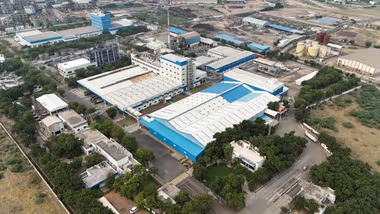
At the Củ Chi production plant in Vietnam, the production of liquid home care products such as OMO laundry detergent was improved thanks to an intelligent mixer powered by an AI digital twin. The system optimised raw material dosing, preventing overuse and delivering 1–2% savings in premium ingredients while maintaining superior product quality.
At the Haldia plant in India, home to powder detergents like Surf and Sunlight, an energy digital twin optimises fan speeds, temperature setpoints and moisture controls, helping achieve a tangible reduction in thermal energy consumption over two years, supporting delivery towards Unilever’s Scope 1 and 2 climate target.
By implementing all these initiatives, Unilever is increasing energy efficiency through smart factory technologies. Digital twins are not only delivering improved productivity and quality but also supporting Unilever’s climate target to reduce absolute operational greenhouse gas emissions (Scope 1 and 2) by 100% by 2030, from a 2015 baseline.
Unilever’s operational excellence, efficiency and sustainable growth across its supply chain have been recognised by the World Economic Forum’s Global Lighthouse Network, where Unilever holds the highest number of designations in the consumer goods sector.
Throughout Unilever’s manufacturing operations, the rollout of digital twins reflects how AI solutions are being implemented with operational intent, enabling real-time simulation, process optimisation and waste reduction.
“Scaling AI across our operations isn’t just a technological shift; it’s a commitment to superior products, sustainability and empowering our teams across our factories,” says Adam Raeburn-James.
Frequently asked questions
What is a digital twin in manufacturing?
Digital twins are virtual models of factory equipment and production lines. They use live data from physical systems on the shop floor to monitor and predict how machines and processes perform.
How is Unilever using digital twins?
Unilever is deploying digital twins across its manufacturing network to improve efficiency, predict issues and optimise production at scale.
What role does AI play in digital twins?
AI powers insights and automation within digital twins, enabling faster decision-making and increasingly autonomous (agentic) capabilities.
What benefits are being achieved?
- Reduced waste
- Improved product quality
- Increased production capacity
- Lower energy consumption
- Faster response to demand
What is the Accenture partnership delivering?
Accenture is supporting the rollout with AI, advanced analytics and scalable infrastructure to expand digital twins globally.
How do digital twins support sustainability?
They optimise energy use, reduce material waste and improve efficiency – helping lower emissions across manufacturing operations.
Related articles

How Unilever is building an AI-first enterprise at scale
Unilever’s Chief Digital & Technology Officer, Sam Kini, shares how AI is unlocking insights and business agility across the value chain to drive product innovation and smarter, faster decisions to better serve consumers and deliver growth.
WEF recognises business impact of Unilever’s supply chain tech investments
Technology is accelerating Unilever’s operational excellence. Our ongoing digital supply chain transformation has driven d‑commerce growth, increased resilience and reduced environmental impact, earning new WEF Global Lighthouse Network designations.

New AI lab to boost innovation, technology and collaboration
Unilever’s newly opened AI Horizon3 Lab is leveraging the power of artificial intelligence and human ingenuity to drive innovation and fast-track growth across the business. We caught up with the team for a taste of what’s to come.