

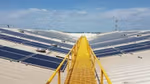
Unilever’s sustainability targets play a critical role in futureproofing our business, ensuring focus and urgency in the areas where we can deliver the most impact. Discover how we’re taking action on our four priority sustainability focus areas: climate, nature, plastics and livelihoods.
Climate reality – our value chain challenge
Climate reality – our value chain challenge
In recent years, we’ve seen climate risks play out in the form of higher and more volatile commodity prices.
Our immediate priority is clear: to make deep cuts in absolute scope 3 greenhouse gas (GHG) emissions by 2030.
Guided by our Climate Transition Action Plan (PDF 7.98 MB) (CTAP), we’re working with our value chain partners to reach stretching science-based targets.[a]
For scope 3 emissions these include:
42% absolute reduction in scope 3 energy and industrial GHG emissions by 2030 (vs 2021)[b]
30.3% absolute reduction in scope 3 forest, land and agricultural (FLAG) GHG emissions by 2030 (vs 2021)[c]
See our progress in our Annual Report and Accounts (PDF 6.16 MB).
We’re focusing our efforts on where we can make the biggest impact, in ways that support business resilience:
- Engaging governments and business to align on climate strategies
- Working with our suppliers on decarbonisation
- Maintaining deforestation-free sourcing of key commodities
- Taking a regenerative approach to farming
- Rethinking our products and ingredients
- Improving packaging design
- Tackling logistics emissions
- Using cleaner, smarter energy in our operations
Building supplier climate capability
Building supplier climate capability
Over 60% of GHG emissions in scope of our net zero ambition come from raw materials, ingredients and packaging.
Our Supplier Climate Programme enables key suppliers to move towards climate leadership.
This includes sharing carbon footprint data for the materials we buy and working with us on decarbonisation opportunities.
Over 2,000 carbon footprint data points collected in 2025
Protecting forests
Protecting forests
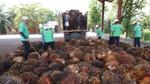
We’re tackling emissions from forests, land and agriculture by maintaining deforestation-free sourcing across our primary deforestation-linked commodities.
In 2025, 97% of our order volumes for palm oil, paper and board, tea and soy were deforestation-free.
We’re using infrastructure and technology and working with suppliers and smallholder farmers to maintain our deforestation-free sourcing.
Over €280m invested since 2021 to directly source deforestation-free palm oil
Scaling regenerative agriculture
Scaling regenerative agriculture
We’re rolling out regenerative agriculture practices –a way of farming that can build resilience to climate change impacts.
It can also lock carbon in soils and regenerate nature, while helping to protect farmer livelihoods.
To enable farmers to adopt these practices more easily, we’re running capability building programmes, while calling for supportive regulations and financial incentives.
0.25 million hectares of land covered by our regenerative agriculture projects since 2021
Where climate meets innovation
Where climate meets innovation
We’re working with partners to reformulate some of our products using lower-emission ingredients, without compromising on performance.
One of our biggest priorities is developing alternatives to fossil-fuel-based chemical ingredients in our laundry and cleaning products.
This is no easy task, so we’re also encouraging the chemicals industry to transform, supported by government policies to unlock a wide-scale transition to renewable and recycled feedstocks.
$120 million joint investment in biotechnology to develop an alternative plant-based ingredient to lather and lift dirt
Decarbonising our operations
Decarbonising our operations
We have reduced our scope 1 and 2 emissions by 77% vs 2015, showing what we can achieve with focus and urgency where emissions fall under our direct control.
We continue to prioritise energy efficiency, renewable electricity and transitioning to renewable heat using heat pumps and electric boilers.
And we’re part of a global business movement calling on governments to accelerate the clean energy transition globally.
Why climate action is a business imperative for Unilever
Climate change isn’t just a significant threat to people and nature – it presents multiple risks to our business.
More frequent and extreme weather events – coupled with biodiversity loss – are expected to reduce agricultural yields and increase economic shocks, with impacts on farmers, suppliers, customers and consumers.
We’ve set ambitious climate targets and identified focused actions on climate and nature to respond to this challenge. This helps us build resilience to supply chain disruption as well as to rising carbon prices.
These targets and actions, and our ambition to reach net zero by 2039 across our value chain, are set out in our Climate Transition Action Plan (PDF 7.98 MB), which was supported by over 97% of shareholder votes at our 2024 AGM.
There are no quick fixes, especially given the extent and complexity of our value chain, but we’re focused on accelerating our progress over the next few years.
What is Unilever’s progress towards its climate targets?
We continue to make progress[d] towards our science-based targets[a] for reducing GHG emissions in our operations and wider value chain. Find out more about our 2025 progress below and in our Annual Report and Accounts (PDF 6.16 MB).
Target: reduce absolute operational GHG emissions (scope 1 and 2) by 100% by 2030 from a 2015 baseline
- We have reduced our scope 1 and 2 GHG emissions by 77% vs 2015, from across our owned and leased sites such as factories, offices, labs and data centres.
- This was achieved by continuing our focus on energy efficiency, renewable electricity and decarbonising our thermal energy consumption.
- We advocate for a faster global clean energy transition, including the wider expansion of biomethane production in Indonesia.
Target: reduce absolute scope 3 energy and industrial (E&I) GHG emissions by 42% by 2030 from a 2021 baseline
- We have reduced our scope 3 E&I GHG emissions by 11% vs 2021 from across a wide range of sources outside of our direct control.[b]
- This has been driven by a combination of purchased material volume decline, availability of supplier-specific Product Carbon Footprint (PCF) data, and improvements in GHG measurement.
- We expect progress against our E&I target to be challenging, given the significant contribution from the petrochemicals sector and end-of-life emissions from surfactants, but we’re engaging with business and government to drive wide-scale change.
Target: reduce absolute scope 3 forest, land and agriculture (FLAG) GHG emissions by 30.3% by 2030 from a 2021 baseline
- We have reduced our scope 3 FLAG GHG emissions by 17% vs 2021 from purchased goods and services associated with ingredients.[c]
- This has been driven by improved data relating to the GHG impact of our deforestation-free sourcing programme for palm oil and the availability of supplier-specific PCFs.
- Our reliance on purchased material volumes for GHG accounting makes it difficult to isolate the impact of specific reformulation initiatives but this is an area we aim to progress in future years.
With 99% of the GHG emissions in scope of our net zero ambition arising outside our own operations, it is essential we engage with partners to drive the critical climate action needed in our value chain. Together, our scope 3 targets represent a 39% absolute reduction in total targeted scope 3 emissions by 2030. Our CTAP does not include the purchase of carbon credits to meet our near-term GHG reduction targets.
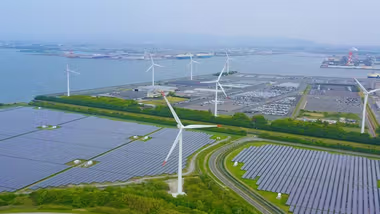
Advocating for wide-scale change
To help us move faster towards our climate targets and our net zero ambition, we’re calling for policies that support business climate action.
Our actions include persuading national governments to:
- Align with business on climate strategies to ensure plans are investible
- Strengthen their targets and plans to reduce emissions
- Prioritise renewables and energy efficiency as pillars of long-term energy security, and transition away from fossil fuels
- Shift the chemicals industry away from fossil-fuel-based chemicals and towards bio-based alternatives
- Make sure carbon is priced appropriately to deliver the Paris Agreement
- Encourage the evolution of the GHG Protocol’s standards to incentivise action along value chains
The UN has warned that although global temperature rise will now inevitably pass 1.5°C, there is still a chance it could be reversed. By calling for policies that create a level playing field and accelerate climate action, we aim to de-risk the transition, helping us move towards net zero without putting our business at a competitive disadvantage.
We’re also engaging our trade associations to align with Unilever on climate policy and proactively support solutions that remove barriers to our climate progress.

How is Unilever leveraging climate finance to help bring solutions to scale?
We know we can have greater positive impact through our climate actions if we work in partnership with other organisations.
Through our Climate & Nature Fund, we have invested €0.5 billion in climate, nature and resource-efficiency projects since 2020, and we have also attracted finance partners to expand our impact.
In 2025, we partnered with HSBC to provide lower-cost, sustainability-linked financing to select suppliers participating in our Supplier Climate Programme in India.
And we’ve joined forces with Axa and Tikehau Capital to form the Regenerative Agriculture Fund, a large private equity initiative to help scale regenerative agriculture globally.

Our Supplier Climate Programme
This programme brings tools and expert support to almost 200 key suppliers whose products contribute most to our GHG emissions.
From chemicals producers and agricultural suppliers to third-party manufacturers, together, they account for over 40% of Unilever’s scope 3 GHG emissions from raw materials, ingredients and packaging.
Our aim is to accelerate their climate journeys to measure, share and reduce the emissions from the materials we buy.

Progress through data and action
We’re working alongside other businesses in the Partnership for Carbon Transparency (PACT) to standardise the collection of product carbon footprint data from suppliers.
Used in place of industry averages, this real-world data gives us a more accurate understanding of our combined climate impact. It helps us and our suppliers to identify, plan and deliver measurable emissions reductions – and track progress along the way.
One example is our work with key can suppliers to reduce aerosol packaging emissions by sourcing aluminium produced with low-carbon energy.
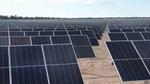
Advocating for renewable energy
We’re partnering with our suppliers to buy renewable electricity in a number of markets such as India, as well as supporting suppliers to access climate finance.
We’re also pushing for a faster global transition to renewable energy.
This involves working with other businesses through initiatives such as RE100 and the We Mean Business Coalition to call on governments to prioritise renewables and energy efficiency and to transition away from fossil fuels.

What is Unilever doing to maintain deforestation-free supply chains?
Our GHG emissions from forest, land and agriculture predominantly arise from land use change, agricultural practices and downstream processing.
We’re focused on reducing these emissions from our primary deforestation-linked commodities: palm oil, paper and board, tea and soy.
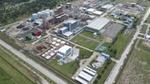
Empowering people, investing in infrastructure and harnessing technology
We’re empowering suppliers and smallholder farmers to embrace deforestation-free practices and have trained around 29,500 smallholders in Indonesia since January 2024.
We’ve invested over €280 million in Unilever Oleochemicals Indonesia (UOI) to increase our direct sourcing of palm feedstocks, to lower the risk of deforestation in our palm oil supply chain.
And we’re using cutting-edge technology, including AI, to increase supply chain traceability and transparency.

Advocating for deforestation-free supply chains
We’re calling for greater alignment between national climate and nature agendas, and greater focus on nature-based solutions that support decarbonisation efforts.
We want governments to adopt and enforce policies to help halt deforestation and conversion of natural ecosystems by 2030.

How is Unilever taking a regenerative approach to farming?
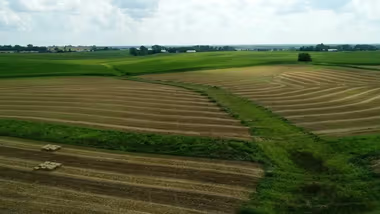
Unilever is working with partners and suppliers to introduce regenerative agriculture practices. This way of farming keeps the soils that grow our ingredients healthy and can help to reduce emissions. It also makes our supply chains more resilient to the impacts of climate change, such as floods and droughts.

Scaling our programmes
We aim to implement regenerative agriculture projects on 1 million hectares of agricultural land by 2030. By the end of 2025, we had implemented regenerative agriculture practices across 254,000 hectares in 17 countries since 2021.
Our work aims to improve soil health, sequester carbon and reduce water use, while regenerating the natural and agricultural ecosystems in our value chain, and supporting the people whose livelihoods depend on them.
We’re targeting the crops that have the biggest land footprint in our supply chains, from soybean and rapeseed oil for Hellmann’s, to vegetables and rice for Knorr. We’re helping farmers build their capabilities and collaborating across shared supply chains to amplify impact.
Understanding and optimising climate impact
We’re collecting data on soil carbon and farming practices to optimise and better manage our projects.
To help us claim reduced emissions, we want to see an industry-wide approach to data handling and reporting on regenerative agriculture projects.
And we’re calling on governments to support farmers through better access to finance, while working with others to grow the regenerative agriculture movement.


How is Unilever reformulating products and using lower-emission ingredients?
Reducing emissions from our products is a difficult and critical challenge that we must overcome. We’ve started to find ways of doing this without compromising on performance and are pushing for industry changes to help bring solutions to scale.
Engaging suppliers to reduce emissions
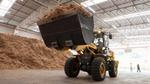
To reduce emissions from the chemical ingredients used in our laundry and cleaning products, we need to decrease the GHG intensity associated with linear alkylbenzene sulphonate (LAS) and soda ash production.
We’re working with key suppliers to do this, securing soda ash produced using biomass and natural soda ash manufactured through less energy-intensive processes that capture carbon.

Innovating new ingredients and formulations
In Personal Care, we’ve reformulated soap bars using patented novel structuring technology to reduce palm oil-derived total fatty matter and scaled this across brands in India and Indonesia.
In Home Care, we want to transition to lower-emission alternatives to petrochemicals. This isn’t easy as solutions aren’t yet commercially available at scale, but we’re taking some steps forward with partners:
- A plant-based surfactant used in our Sunlight hand dishwash product
- A joint biotech investment in sugar cane to extract plant-based oil
- A partnership with a tech start-up to explore renewable carbon
We’ve also expanded our Persil Wonder Wash laundry detergent range, specially formulated for shorter cycles.

Collaborating for change
We’re engaging policymakers, NGOs, industry, academics and trade associations to drive a faster transition of the chemicals industry. Not only does this allow us to shape the agenda, it also de-risks the transition by ensuring industry alignment.
Lower-carbon synthetic soda ash can only be scaled with cooperation between end-users, manufacturers and the fertiliser industry. That’s why, in India, we’re leading a working group aiming to move the chemicals industry towards net zero.
What actions is Unilever taking to reduce emissions from packaging?
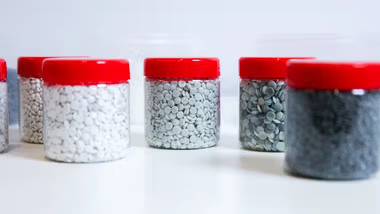
While plastic is often the lowest carbon footprint packaging option compared to other materials, the plastic packaging we use for our products is a source of our GHG emissions.
Reducing our virgin plastic use and making our plastic packaging recyclable, reusable and compostable are important levers to reduce GHG emissions from packaging.
Reduction, circulation, collaboration
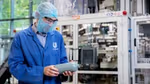
We’re taking steps to reduce emissions from plastic production and its end-of-life treatment:
- We’re finding ways to remove plastic from our packaging by designing new product formats
- We’re moving from virgin, fossil-fuel-derived materials to recycled and renewable feedstocks
- We’re working with others to push for better recycling and collection infrastructure

Making progress on plastics
In 2025, we reduced our use of fossil-fuel-derived virgin plastic by 29% vs a 2019 baseline.
We also achieved 25% recycled plastic in our packaging, with 57% of our plastic packaging now reusable, recyclable or compostable.
And, in 2025, through our purchase of recycled plastic, strategic partnerships and participation in extended producer responsibility (EPR) schemes, we collected and processed more plastic than we sold.

How is Unilever tackling logistics emissions?
We rely on transportation to source materials and ingredients and bring our products to customers around the world.
Most of our logistics emissions are linked to our global road transportation, so we’re focusing our efforts on transforming our road network, optimising routes, filling containers and reducing journeys travelled.

Shifting to alternative fuels
We’ve started transitioning some of our fleets to alternative fuels in some of our biggest markets.
For example, in Europe, we continue to increase our use of hydrotreated vegetable oil (HVO), while in North America, we’re shifting from diesel to renewable natural gas (RNG) on specific lanes.
Electrifying our future
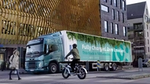
Over the long term, we’ll be moving to electric or hydrogen-fuelled trucks.
We’ve already scaled up the use of electric vehicles in Greater Asia, Greater China and Latin America, as well as Pakistan, Turkey, Arabia and Bangladesh (PTAB).
How is Unilever using renewable energy in its operations?
From our factories and offices to our labs and data centres, how we power and heat our owned and leased buildings is in our direct control.
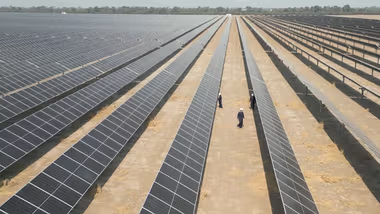
We’ve successfully transitioned to renewable sources for much of the electricity used at our sites. Alongside becoming more energy efficient, this has been our biggest driver in reducing our scope 1 and 2 emissions by 77% since 2015.

Transitioning to renewable thermal energy
Now, we’re focusing on transitioning the heat used in our production processes. Given the scale and diversity of our manufacturing network and various market complexities, this is a considerable challenge.
In 2025, we scaled up the electrification of thermal energy by installing industrial-scale heat pumps at sites in the Philippines and India, and we increased our use of electric boilers with an installation at our Cavite site in the Philippines.
In Brazil and Indonesia, we’re transitioning to biomethane, including at UOI – our largest GHG emitting site.
Powering our sites with renewable electricity
In 2025, 88% of the electricity consumed at our sites was from renewable sources.
We are putting in place wind and solar Power Purchase Agreements (PPAs), and have done so in Poland, India and Spain.
Where renewable electricity isn’t yet available from local suppliers, we’re buying certificates for renewable electricity generated in neighbouring countries, following RE100 Reporting Guidance 2022.

Working with other companies to speed up the clean energy transition
We were one of the first companies to join RE100 and signal our commitment to 100% renewable electricity.
We signed a joint statement coordinated by RE100, urging ministers and business leaders to prioritise renewables and energy efficiency as pillars of long-term energy security.
During COP30, we supported the We Mean Business Coalition’s statement urging governments to commit to a roadmap on the transition away from fossil fuels.
Our other sustainability priorities

Nature
The world – and our business – needs resilient natural and agricultural ecosystems to thrive. We’re committed to contributing to the protection and regeneration of nature within and beyond our value chain.
Plastics
We’ve been working hard to create a circular economy for plastic packaging for a number of years. We’ve learnt that transformation takes time. Given the size of this challenge, we’re using our innovation capabilities to find new, scalable solutions.

Livelihoods
The impacts of inequality go far beyond income – to health, human rights and economic growth. So we’re working to improve the livelihoods of people in our global value chain.
[a]
(1, 2) Our scope 1 and 2 target was set versus a 2015 baseline using the market-based approach. It was first validated in 2017 by the Science Based Targets initiative (SBTi) as compatible with a 1.5°C pathway in line with the Paris Agreement. In 2024, SBTi validated that our proposed scope 3 targets conform with the SBTi Criteria and Recommendations for Near-Term Targets version 5.1. We selected a 2021 baseline date for our scope 3 targets, for which we have more accurate data. We regularly review our approach with SBTi.
[b]
(1, 2) Energy and industrial emissions from purchased goods and services (associated with ingredients and packaging), upstream transport and distribution, energy and fuel-related activities, direct emissions from use of sold products (associated with HFC propellants), end-of-life treatment of sold products, and downstream leased assets (associated with ice cream retail cabinets).
[d]
Following the demerger of our Ice Cream business on 6 December 2025, all territories and activities within the scope of the Ice Cream business have been treated as discontinued operations in our consolidated financial statements. As a result, our sustainability progress metrics focus on our four continuing Business Groups (Beauty & Wellbeing, Personal Care, Home Care and Foods). However, Unilever’s overall 2025 performance towards our scope 3 targets was measured including Ice Cream. No adjustments to baseline values, base years or targets were made for the demerger of our Ice Cream business. This will be reassessed in 2026. See our Annual Report and Accounts 2025 for more details. (PDF 6.16 MB)