
Palm Oil Story
Overview
Our palm oil supply chain
Palm oil is a highly versatile and land-efficient oil crop. It has many uses, including foaming, binding and stabilising, which is why it’s a key ingredient in many products.
But the rapid expansion of the industry has meant that, in some areas, rainforests are being cut down to make way for new planting – a key driver of climate change and biodiversity loss. The expansion of palm oil plantations can also lead to a range of human rights issues, including land conflicts between plantation companies and local and Indigenous communities.
These are challenges that must be urgently addressed. As a major palm oil buyer, Unilever has an important role to play.
Palm oil sourcing is complex, and we recognise there are limitations. However, in 2025, 96.8% of our purchase order volumes of palm oil were deforestation-free, based on our requirements( a , b ) and we sourced 84% sustainably, according to our definitions.( c ) Our progress is assessed annually, based on defined scope, volumes and verification approaches.
Scroll down to understand the actions we’re taking in our palm oil supply chain.
Suppliers
The critical first mile
Unilever has more than 100 direct palm oil suppliers and we source most of our palm oil from large-scale concessions and plantations. We require our direct suppliers to have enforced a zero-deforestation and zero-conversion supply chain since December 2015.
We onboard new suppliers though a rigorous due diligence and transformation programme, requiring compliance with the No Deforestation, No Peat, and No Exploitation implementation framework (NDPE IRF) before entry. We embed the principles of our People & Nature Policy (PDF 2.04 MB) and related guidelines (PDF 1.63 MB) into our supplier contracts and work with our suppliers to help them implement sustainability policies and practices.
The four key principles of the policy that we expect suppliers to adhere to in their operations and supply chains are:
- Protecting natural ecosystems from deforestation and conversion
- Respecting and promoting human rights
- Ensuring transparency and traceability
- Being a force for good for people and natureuol-c-story-chapter
For example, since 2018 we’ve worked with PT Perkebunan Nusantara (PTPN), the Indonesian government-owned plantation and a significant supplier of palm oil to Unilever. We provide resources, funding and technical expertise to help PTPN obtain Roundtable on Sustainable Palm Oil (RSPO) certification for its plantations and mills across Sumatra. We also help the smallholders in its supply chain meet our sustainability expectations.

We monitor the performance of our suppliers through a combination of tools including our own independent verification mechanism (PDF 1.36 MB), the use of traceability technology, and other reporting tools such as the NDPE IRF. Should we find non-compliance we act swiftly, following our three-step process below.
Smallholders
Around 40% of the world’s palm oil is sourced from smallholder farmers, but they are generally unsupported with no permanent ties to a larger plantation or mill. They often have low-quality trees and can’t afford technical advice to improve their productivity, which puts more pressure on forests.
By formally bringing smallholders into our supply chain, we aim to drive positive impact on the ground, increase productivity, and build business resilience by increasing the supply of sustainable, deforestation-free palm oil, which may continue to be constrained – especially palm kernel oil (PKO).
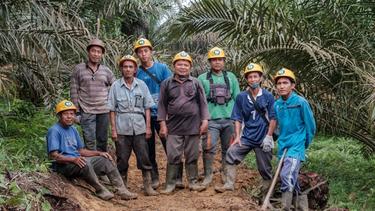
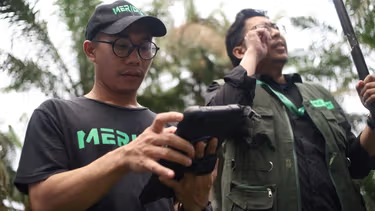
To learn more about the smallholders in our palm oil supply chain, we work with trusted partners including Fortasbi, IDH, Kompasia, Konservasi Indonesia, Meridia, SNV, Widya Erti Indonesia, and the World Resources Institute to better understand the communities supplying the mills we buy from.
With farmers’ consent, our partners create polygon maps of their smallholdings and find out about the quality of the trees and soil, the challenges people face, and their family situations. This information helps us decide how best to support them. So far, we’ve mapped more than 55,000 smallholders, and we’re continuing this important work over an increasingly large area.
Crucially, we also provide a range of training programmes through our three smallholder hubs across North Sumatra, Aceh and Riau in Indonesia. These programmes, covering around 90,000 hectares, help drive the uptake of regenerative and sustainable farming practices that boost productivity and incomes, guided by our Sustainable Agricultural Principles (PDF 5.01 MB).
We’ve supported around 29,500 smallholders this way, helping us build a reliable source of palm oil that is aligned with our standards.
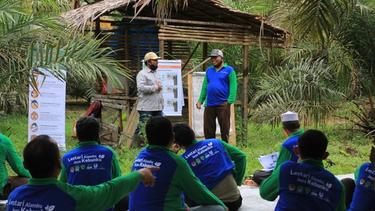
The training includes support with various legal documents needed and the implementation of good agricultural practices (GAP) to obtain RSPO certification. By the end of 2025, we had helped more than 18,000 independent smallholder farmers (ISF) obtain RSPO certification via our programmes with partners. As one of the largest buyers of independent smallholder RSPO credits we incentivise smallholders and support their livelihoods by creating a market for smallholder-grown sustainable oil palm.
We also upskill smallholders to negotiate directly with independent mills. Increasing farmers’ incomes can lessen the need to expand their farms and help them become allies in protecting and regenerating nature.
Traders
Trading with traceability
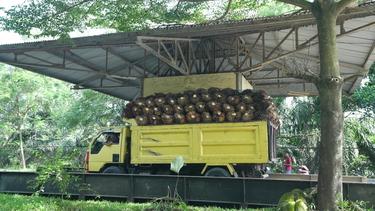
Traders are an integral part of our palm oil supply chain. As intermediaries, they buy fresh oil palm fruit bunches from smallholder farmers and sell them on to other traders or mills.
Farmers leave their fruit at collection points, which are often informal and located some distance from their land, where it’s picked up by traders who often mix it with fruit from other farmers. This makes it hard to know whether the oil palm fruit was produced sustainably.
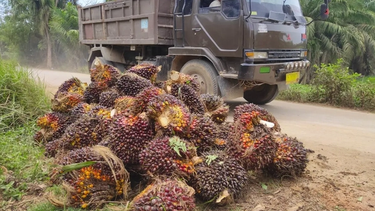
In Sumatra, we’re working with PemPem which created an app to digitise the transactions of the fresh oil palm fruit produced by smallholders and monitor its movement in the critical first mile. The app is used by smallholders in our supply chain to access the market and get fairer prices for their fruit.
PemPem acts as a market maker, matching onboarded smallholders with bids for fresh fruit bunches from mills. It then facilitates the transaction, with traders delivering the fruit to the mill.
Mills
The processing check point
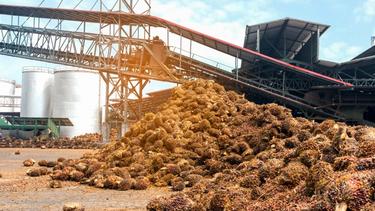
Mills are the critical link between plantations and refineries, processing fresh fruit bunches (FFB) into crude palm oil (CPO) and palm kernels (PK) within 24 hours of harvest. They provide a key opportunity to identify the source of the fruit, with controls in place to identify and address deforestation risk. There are now over 400 mills in our palm oil supply chain, significantly reduced from over 1,600 in recent years.
The independent mills (single mill companies without plantations) we work with, which source from smallholder farmers, must tell us where they buy their fresh fruit bunches. When we bring a mill into our supply chain, we work together to establish a sustainability roadmap that we then embed into their contract.
We support these mills to build their capacity to meet our sustainability standards through the use of geospatial technology that helps unlock greater visibility in the critical first mile. We also provide training on the responsible sourcing and production practices set out in our People & Nature Policy (PDF 2.04 MB) and Sustainable Agricultural Principles (PDF 5.01 MB), including:
- Guidance from RSPO on managing peat and protecting High Carbon Stock (HCS) forests via the High Carbon Stock Approach (HCSA) toolkit, as well as help in obtaining RSPO certification
- Participation in our smallholder programmes and guidance on reporting on improvements in the sustainability of their agricultural practices.
We also engage mills on the need for decarbonisation. In Indonesia, we have already started sourcing palm oil mill effluent (POME) from local mills to create biomethane for use in our operations. By demonstrating the potential of this type of partnership, we aim to encourage wider industry adoption over time.
Refineries and beyond
Product-ready palm oil
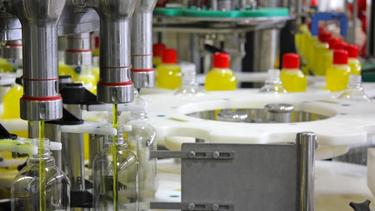
Refineries and oleochemical plants turn CPO and PKO into a liquid or solid that we then use as an ingredient in various products sold worldwide.
Our contracts with refineries require them to work in line with our People & Nature Policy (PDF 2.04 MB) or have an equivalent sustainability policy of their own. They must also provide us with a list of their supplier mills.
Each refinery directly supplying our factories must also comply with our Responsible Partner Policy (PDF 4.45 MB), and we ensure that their facilities are regularly audited.
We’ve also brought some of our PKO refining in-house. Since 2021, we’ve invested over €280 million to expand Unilever Oleochemical Indonesia (UOI), our facility in Sei Mangkei, North Sumatra.
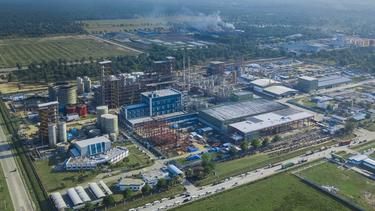
As well as refining PKO and increasing our R&D capacity, UOI’s expansion has dramatically simplified our palm oil supply chain in this area. We now buy palm feedstocks directly from mills instead of from traders. We source from fewer than 150 mills, and they buy directly from plantations and independent smallholders, further increasing traceability and our ability to have direct positive impact on the ground. This has also improved cost efficiency for our business.
The refined palm oil is then either used in manufacturing at UOI – where operations are increasingly being fuelled by biomethane made from palm oil waste – or transported to other factories around the world.
Global Procurement
Driving sustainability
Measuring and reporting deforestation risk
Unilever’s Procurement Sustainability team works with others to monitor deforestation and peat conversion, and helps ensure there is compliance with our policies, from one end of our palm oil supply chain to the other.
Our use of technology is key:
- We’ve invested in radar technology to more quickly detect deforestation, and the results are shared transparently through the Global Forest Watch platform.
- Our No Deforestation, No Peat Conversion, No Exploitation (NDPE) dashboard is our one-stop interactive platform, holding Google Earth satellite imagery as well as deforestation alerts, grievances and other supply chain information. It gives us increased visibility across more than 20 million hectares of oil palm farms and over 2,000 mills from the Universal Mill List (UML), as well as the 55,000+ smallholders that we’ve mapped so far.
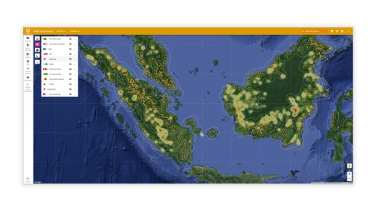
The dashboard indicates that, as of 2025, we have 97.6% traceability to mill and 97.4% traceability to plantation for in-scope volumes of palm oil. This means we have good knowledge of where the fruit is grown and where it is crushed. It also helps us spot any issues quickly so we can work to address them as soon as possible.
As well as leveraging technology, we monitor our supply chain through supplier group-level due diligence profiling and regular monitoring reports on deforestation, peat conversion and burnt areas provided by Inovasi Digital Untuk Transformasi/ Earthqualizer , which draws on data, risk intelligence and supplier engagement.
We have also conducted a forest footprint mapping exercise (PDF 12.38 MB) to better understand the areas potentially impacted by our palm oil sourcing and to help us prevent issues from arising. This uses a combination of supplier information, concession boundaries and landbanks, indicative sourcing algorithms, deforestation alerts, biodiversity and carbon layers, and social indicators.
Respecting and promoting human rights in our value chain
Everything we do is underpinned by our commitment to respect and promote human rights throughout our operations.
Our approach is governed by the Unilever People & Nature Policy (PDF 2.03 MB) and related guidelines (PDF 1.63 MB), our Human Rights Policy Statement (PDF 4.42 MB), and our Unilever Principles in Support of Human Rights Defenders (PDF 2.9 MB), which are grounded in international standards. We communicate our requirements to suppliers in our Responsible Partner Policy (PDF 4.45 MB), and we engage a third party to audit compliance.
At the beginning of 2024, we began a broader three-year human rights programme to accelerate and upscale our work to achieve positive impacts on people. We are continuing our efforts by developing an independent verification methodology, which aims to provide proof that Free, Prior and Informed Consent (FPIC) is being conducted in our palm oil supply chain. We plan to pilot and publish this in 2026.
Taking a landscape approach
Unilever also invests in landscape programmes near our sourcing areas in Indonesia and Malaysia. This means engaging a wide range of stakeholders within a jurisdiction on plans and activities to protect and restore nature, with the aim of lowering deforestation risk and creating a more positive impact in these strategic sourcing areas.
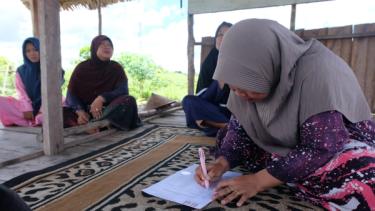
Our Reimagining Landscapes Report (PDF 14.04 MB) describes how we’re supporting landscape programmes in South East Asia – in the provinces of Aceh, North Sumatra, Riau and Central Kalimantan in Indonesia, and in Sabah, Malaysia. And our Reimagining Landscapes Google Earth story takes viewers into the heart of these landscapes to meet the communities and organisations working there and experience the ecosystems we’re helping to restore.
Influencing wider industry
Ensuring a sustainable future for palm oil goes beyond our own supply chain. It requires the transformation of the industry.
To drive this, we’re working through partnerships, advocacy and committed on-the-ground initiatives to lead real progress towards our vision of a palm oil supply chain where sustainability is commonplace.
We are members of industry groups and coalitions including:
- Roundtable on Sustainable Palm Oil
- Consumer Goods Forum – Forest Positive Coalition
- Palm Oil Collaboration Group
- Malaysian Sustainable Palm Oil Standard – Impact Alliance
Downloads:
- People and Nature Grievance Tracker (PDF 1.32 MB)
- People and Nature Grievance Mechanism (PDF 178.27 KB)
- Suspended or No-Buy List of Palm Oil Companies (PDF 553.45 KB)
- People and Nature Policy (PDF 2.04 MB)
- People and Nature Policy Guidelines (PDF 1.63 MB)
- Responsible Partner Policy (PDF 4.45 MB)
- Sustainable Agriculture Principles (PDF 5.01 MB)
- Unilever Principles in Support of Human Rights Defenders (PDF 2.9 MB)
- Human Rights Policy Statement (PDF 4.42 MB)
- Unilever Oleochemicals Indonesia 2024 mill list (PDF 319.25 KB)
- Our response to grievances raised against Astra Agro Lestari (PDF 48.04 KB)
- Forest Risk Commodities Report (PDF 4.85 MB)
For details of volumes in scope, please see our published Basis of Preparation (PDF 6.16 MB)
Following the demerger of our Ice Cream business on 6 December 2025, all territories and activities within the scope of the Ice Cream business have been treated as discontinued operations in our consolidated financial statements. As such, our stated progress on deforestation-free palm oil does not include palm oil sourced as an ingredient for ice cream.
We report on core palm oil volumes that include all volumes of palm oil and palm kernel oil, but excludes palm fatty acid distillates (PFAD), which are a by-product of the refining process, and tail ingredients used in our products. In 2025, 84% of our core palm oil volumes was sourced sustainably (100% for palm oil and 69% for palm kernel oil). We define this as either produced according to third-party certification and aligned with Unilever’s Sustainable Agricultural Principles or purchased from non-sustainable sources but matched with credible credits representing verified sustainably sourced raw materials. 67% of our sustainably sourced palm oil came from certified sources: RSPO Mass Balance, RSPO Segregated or an equivalent standard that is independently verified by a third party, and 17% was achieved via RSPO independent smallholder credits. We continue to be one of the largest buyers of these credits due to the unavailability of physically sustainable (certified) sources in some markets and our ambition to directly support the livelihoods and sustainable palm oil journey of smallholders.
Content provided by third-parties may not meet our desired accessibility standards.
Javascript is required for this feature.