

AI is increasingly influencing everyday food decisions, with algorithms now shaping much of what shoppers search for, see and ultimately buy.[a]
The result is that brands now need to win the attention of consumers and algorithms if they want to grow in this fast‑changing landscape.
“AI is helping our Power Brands deliver on both counts,” says Olivia Kirby, Director of Integrated Demand Generation, Foods.
“It is fuelling the innovation, visibility and personalisation we need to ensure that our Power Brands, including Hellmann’s and Knorr, as well as Unilever Food Solutions, stay unmissable, on-trend and irresistible.”
Staying unmissable with consumers, algorithms and large language models
Product discovery in Foods, as in most sectors, is increasingly powered by AI-driven search and conversational tools. In today’s retail landscape, brands need to be present not just on shelves, but also in digital search answers.
Research indicates that nearly 50% of AI search users use agentic tools to inform purchase decisions about food and beverages. And with 29,000 questions being asked per second on ChatGPT alone (source: OpenAI 2025), cutting through the noise has become business critical.
“To address this, our Foods business is using AI search visibility platforms to understand how our brands perform across large language models (LLMs), identify any gaps and refine content strategies as needed,” says Meenakshi Burra, Foods Chief Digital & Information Officer and Chief Data Officer.
A high-impact example was seen in the run-up to the 2026 Big Game in the US, when Hellmann’s identified a visibility gap around the search prompt ‘Game Day sandwich recipes’.
Having established that the brand’s low visibility was driven by a lack of listicle-style content, Hellmann’s instigated a rapid website content fix. This included creating a dedicated Game Day sandwich listicle, updating descriptions with relevant keywords, reframing existing content into AI-friendly listicle formats and expanding the brand’s recipe section.
As a result of this approach, the brand achieved a 10-position boost in visibility rankings and an increased overall visibility score that almost doubled the 10% benchmark, improving its likelihood of being recommended to consumers searching for relevant recipes.

Accelerating innovation from concept to cart
But visibility is only the first step in driving sales. Brands also need to stay relentlessly relevant by offering products that reflect what and how people want to cook in a digital landscape where food fashions are moving at unprecedented speed.
“Food trends are no longer measured in years; they move at the pace of cultural conversation,” says Olivia.
“What goes viral today can shape what people want to cook tomorrow. To stay relevant and desirable, brands must innovate at speed – and that is why AI matters for our brands.”
To support this, our R&D teams are using AI-powered product development to accelerate innovation and keep our brands ahead of the curve. Instead of testing ideas individually, AI can explore thousands of recipe variations in seconds.
“For our scientists in Foods, AI isn’t just a time-saver. It’s changing how we discover, collaborate and innovate,” explains Heike Steiling, Chief R&D Officer of Foods, adding that AI is nevertheless not a replacement for human creativity.
“In fact, AI is a tool that actually gives product developers back the time they need to explore their culinary creativity.”
For example, by recognising patterns in taste, product data and customer feedback, AI can generate insights that help predict which product variants consumers are most likely to love. This means teams can choose the strongest direction much earlier and move into physical trials and development with far greater confidence and precision.
A standout example is Knorr’s Fast & Flavourful Paste. Using AI, Foods R&D teams digitally tested a wide range of recipes before any live testing began. By identifying the best flavour and texture combinations upfront, the teams were able to minimise physical testing, cutting development time in half.
Hyper‑personalisation for Unilever Food Solutions
With research showing that 71% of consumers expect tailored interactions from companies, personalisation is another key consumer expectation that AI is helping our brands to meet.[b]
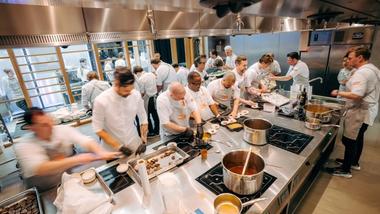
For example, our professional foodservice business, Unilever Food Solutions (UFS), is leveraging AI to deliver hyper‑personalised customer recommendations in order to help foodservice operators gain a competitive edge.
Unlike other systems that scrape the internet for information, the UFS digital experience is built on proprietary data, extensive industry and trends research, a library of 35,000 chef-authored recipes, culinary and product resources, and the collective expertise of 250 UFS chefs working across 75 markets.
“By combining this powerful data foundation with real business details from the operators – including website information, menus, customer reviews and publicly available social content – we can provide real-time analysis that delivers solutions and suggestions that address genuine challenges and opportunities facing each customer’s unique operation,” says Nuria Hernández-Crespo, UFS CEO.
“This is AI applied with purpose, enabling Unilever Foods to translate data into practical insights that help foodservice operators and UFS succeed, now and in the future.”
Frequently asked questions
How is AI used in food innovation?
At Unilever, AI analyses consumer data, emerging trends and product performance to help brands develop new products faster.
How does AI support Unilever food product development?
AI helps Unilever develop great-tasting recipes, optimise ingredients, and accelerate research and development processes.
How does AI accelerate food innovation at Unilever?
AI can simulate everything from product quality to consumer insights and preferences to testing new products on production lines long before physical trials begin. In packaging, AI can help predict how formulations behave in bottles, enabling improvements like the Hellmann’s Easy-Out squeeze design, saving months of physical testing. As a result, AI can help Unilever develop alternative and winning formulations and more sustainable products faster, which can help to reduce supply chain risks, minimise waste and support our business growth.
Related articles

How AI is transforming innovation in Unilever Beauty & Wellbeing
Unilever’s Beauty & Wellbeing scientists are using AI to decode consumer trends and mine decades of research data. The result? Products designed in days instead of months, and actionable insights rooted in real consumer desires. Here’s how it works.
Hellmann’s NBA brand collaboration scores new fans and growth
The Hellmann’s–NBA collaboration has tapped into the power of Brazil’s more than 57 million NBA fans with a sports-to-sales strategy that’s delivering growth, brand premiumisation and Gen Z brand engagement for Hellmann’s winning line-up of flavoured, squeeze-bottle mayos. Here we look at what is powering this success story.

Knorr’s campaign for Gen Z daters drives Desire at Scale
For 93% of Gen Z, cooking is the ultimate green flag on a dating profile. Discover how Knorr used this insight in a social-first influencer campaign that embedded the brand authentically in Gen Z dating culture to drive growth.