
Skip to content
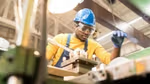
Man wearing hard hat and safety glasses working at a machine in a workshop

Respect human rights

Human rights are fundamental to the fairer, more socially inclusive world we want to see. That’s why respect for human rights is a non-negotiable part of doing business with Unilever, a commitment that is core to our company values.

In 2011, we publicly endorsed the United Nations Guiding Principles on Business and Human Rights (PDF 1.08 MB) (UNGPs) and in 2015 published the first standalone human rights report (PDF 4.53 MB) using the United Nations Guiding Principles Reporting Framework. Since then, we’ve continued to develop our approach to addressing potential and actual impacts in line with the maturing business and human rights landscape.

Our human rights strategy is grounded in the principles of effective human rights due diligence (PDF 1.86 MB), with clear governance processes for delivery of our strategy. We have identified our salient human rights issues, defined by the UNGPs as 'the human rights that are at risk of the most severe negative impacts through a company’s activities or business relationships'. This helps us prioritise how we address human rights impacts across our operations and value chain. Further information can be found in our Human Rights strategy in the UNGPs Reporting Framework (PDF 100.91 KB).

Our salient human rights issues:

  • Bullying and harassment
  • Discrimination
  • Fair wages and income
  • Forced labour
  • Freedom of association and collective bargaining
  • Health
  • Land rights (including Indigenous Peoples' rights)
  • Working hours

Our strategy embeds respect for human rights within our own business, our value chain and wider society. See below to find out more about our approach to each:

A man in a hard hat and high visibility waistcoat studies a dashboard in a factory

Human rights in our own operations

Each and every person within our business deserves to have their rights respected.

A woman checks out young plants in pots on a palm oil plantation in Indonesia

Human rights in our value chain

Our value chain connects us with millions of people and our strategy aims to embed respect for the rights of all throughout our entire value chain.

Progress on delivering our strategy

As part of our commitment to the UNGPs, we provide regular updates on the progress of our strategy in our Annual Report and Accounts, Modern Slavery Statements and in the case studies published below:

Man with glasses looking closely at a noticeboard.

Strengthening human rights due diligence in our value chain (PDF 178.63 KB)

We're collaborating with implementation partners to support our business partners strengthen their human rights due diligence through worker-led surveys and management maturity assessments. Insights from workers are informing action plans to address issues including harassment, discrimination and unsafe working conditions. We're scaling the programme deepen impact and expand to new geographies through a supplier-led cascade model.

Lady in warehouse.

Strengthening business partner practices (PDF 96.96 KB)

Unilever's Responsible Sourcing Programme helps prevent harm, drive improvements and ensure accountability for human rights across our global value chain. Through risk assessments, on-site audits and corrective action plans, this programme aims to strengthen policies and practices that protect workers and support suppliers in meeting our standards.

Three women in traditional clothing sit on a tiled step. They are surrounded by baskets, bamboo sticks, and household items in an outdoor setting.

Rightsholder engagement guidance (PDF 123.4 KB)

Unilever’s rightsholder engagement guidance supports inclusive, trust-based engagement, helping teams identify, prioritise and engage rightsholders. It is at the core of our approach to human rights due diligence.

Two people in hard hats looking at a laptop

Technology solutions for human rights (PDF 250.39 KB)

We explore technology solutions and experiment with new approaches that may help in tackling human rights issues. We piloted a new prototype over a 5-month period that aimed to create a more systematic and automated way to identify and classify potential impacts.

Two people in hard hats in a factory chatting and looking at a laptop

Advancing fair compensation

Our goal is to have 50% of our procurement spend with suppliers who signed the Living Wage Promise by 2026. Since launching our Framework for Fair Compensation, we became living wage compliant and were accredited by the Fair Wage Network in 2021. We are extending this commitment to our supply chain.

Farmer in field looking out over crop

Modern slavery (PDF 133.36 KB)

Engaging with workers helps us to improve our approach to detecting, preventing, and resolving issues. We recently commissioned an independent review of a supplier recruitment fee remediation process which included extensive engagement with migrant workers to understand their experiences.

A smiling lady in traditional dress in India.

Women in our value chain (PDF 87.33 KB)

Unilever participates in multistakeholder platforms to collaboratively address discrimination and harassment in key commodity supply chains, including through the Women's Safety Accelerator Fund (WSAF), which aims to create safer workplaces for women in our tea supply chain.

Evaluating our progress

Our work is mapped to the UNGPs reporting framework (PDF 100.91 KB) and we have also developed an impact measurement framework to evaluate the impact of our human rights due diligence approach.

Downloads library:

Please visit Our policies | Unilever for policies related to human rights.

Back to top